Blast chiller vs. regular freezer : The real difference, and does your kitchen actually need one? We break down the science, food safety rules, and ROI so you can decide with confidence.
Blast Chiller vs. Regular Freezer: Which One Does Your Commercial Kitchen Actually Need?
Ask ten commercial kitchen operators whether they need a blast chiller, and you’ll get ten different answers. Some will say it’s an absolute non-negotiable. Others will tell you their regular freezer does the job fine. A surprising number aren’t entirely sure what a blast chiller actually does differently.
This guide settles the debate once and for all. We’ll break down exactly how each piece of equipment works, where food safety laws draw the line, which kitchen types genuinely require a blast chiller, and when a high-quality upright or chest freezer is all you need. By the end, you’ll have a clear answer specific to your operation.
The short answer, before we go deep: a blast chiller and a freezer serve fundamentally different purposes. One is for rapidly reducing the temperature of hot, freshly cooked food. The other is for long-term cold or frozen storage. Most professional kitchens cooking in volume need both.
What Is a Blast Chiller, And How Does It Actually Work?
A blast chiller is a piece of refrigeration equipment designed to do one specific thing extremely well: reduce the core temperature of hot cooked food rapidly and safely.
When you pull a tray of roast chicken, a batch of soup, or a hotel pan of lasagne out of the oven, it’s typically sitting at 70–90°C. Left to cool at room temperature, that food spends an extended period passing through what food scientists call the temperature danger zone, between 60°C and 5°C, where bacterial growth occurs at its fastest rate.
A blast chiller eliminates that risk. By blasting high-velocity chilled air across the food at temperatures as low as -30°C, it drives the core temperature of the product from 70°C down to below 3°C in under 90 minutes. That’s well within the safe cooling window required by HACCP (Hazard Analysis and Critical Control Points) guidelines and the Food Standards Australia New Zealand (FSANZ) code.
HACCP Rule: Cooked food must be cooled from 60°C to 21°C within 2 hours and from 21°C to 5°C within a further 4 hours. A standard freezer cannot reliably achieve this for bulk quantities of hot food. A blast chiller is engineered specifically to meet this requirement.
Most modern blast chillers also have a blast freeze mode, which takes food all the way down to -18°C or below for long-term frozen storage, locking in quality, texture, and nutritional value at the point of peak freshness.
What Does a Regular Commercial Freezer Do?
A standard commercial freezer, whether an upright storage freezer, chest freezer, or underbench freezer, is designed to maintain cold or frozen product at a stable temperature. Typically between -18°C and -22°C for frozen storage, or 0°C to 4°C for chilled storage.
What a standard freezer is not designed to do is accept large quantities of hot or warm food and bring them rapidly down to safe temperatures. When you load a hot hotel pan into a conventional freezer, two things happen that you do not want:
The internal temperature of the freezer rises significantly, potentially pushing other stored products into unsafe temperature territory.
The food itself cools far too slowly in the core, sitting in the bacterial growth zone for hours rather than minutes.
Beyond food safety, loading hot product into a standard freezer stresses the compressor, forcing it to work far harder than it’s rated for, shortening its service life and driving up energy consumption.
Browse our full freezer range: Upright Storage Freezers | Chest Freezers | Underbench Freezers
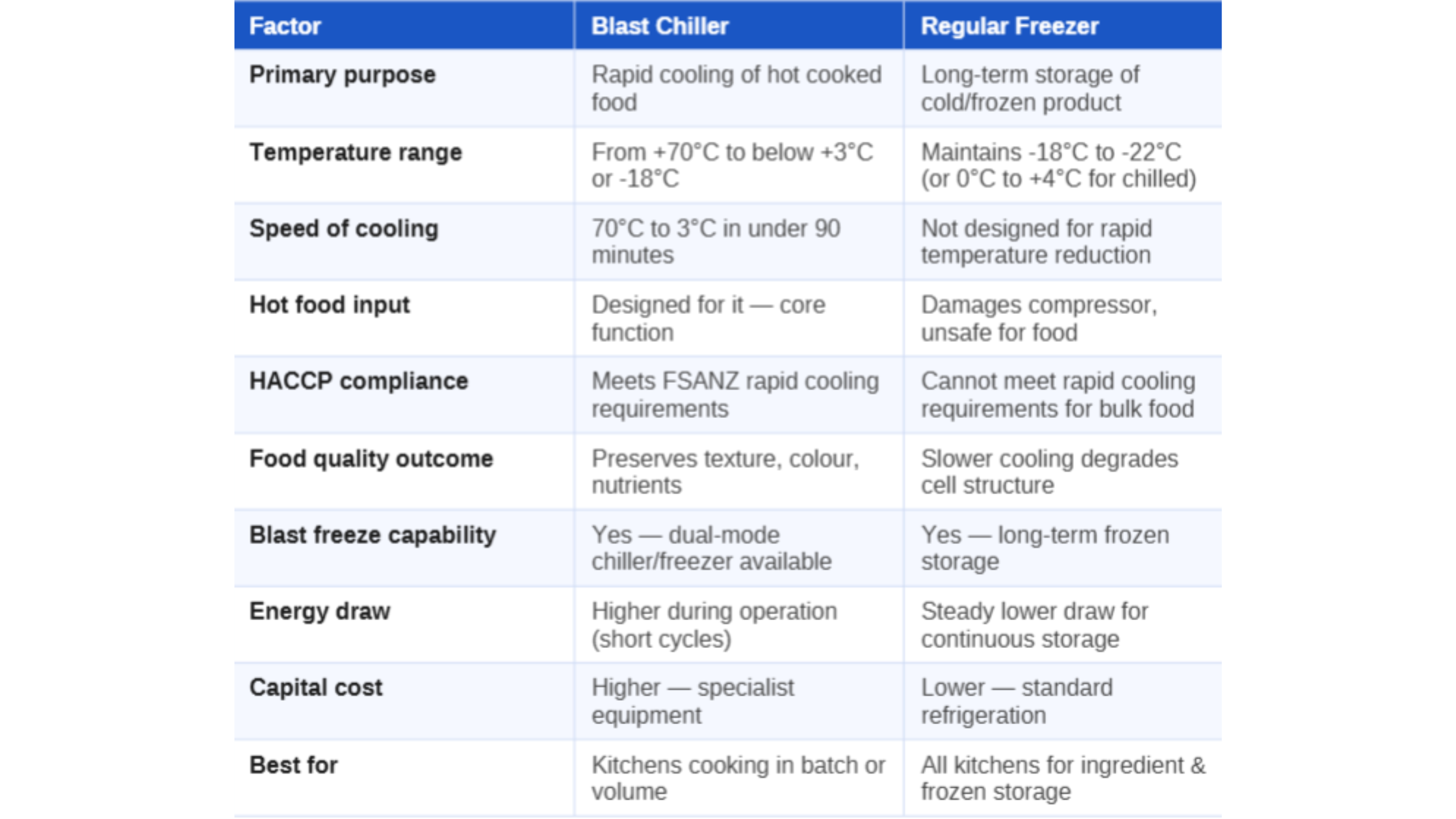
Side-by-Side Comparison: Blast Chiller vs. Regular Freezer
Here are the key differences laid out clearly so you can make a direct comparison:
The Food Safety Case: Why Blast Chilling Is Not Optional for Many Operations
Under the Food Standards Australia New Zealand (FSANZ) Food Safety Standard 3.2.2, food businesses must ensure that potentially hazardous food is cooled as quickly as possible. The standard specifies that food must be cooled from 60°C to 21°C within 2 hours, and from 21°C to 5°C within a total of 6 hours.
For small batch cooking, a single pot of sauce, a tray of biscuits, ambient cooling followed by rapid transfer to a cold room or fridge can often meet this requirement. Or, volume cooking, multiple hotel pans of roasted meats, large batches of soups, bulk rice or pasta, meeting those timeframes without a blast chiller becomes genuinely difficult to demonstrate and audit.
Food safety auditors know this. If your operation is cooking in bulk and you cannot demonstrate a reliable, documented rapid cooling process, you are exposed, both in terms of food safety risk, and compliance liability.
A blast chiller solves this problem. Most modern units include a built-in temperature probe and data logging capability, creating an automatic, auditable record of every chilling cycle. That’s exactly the kind of documentation a food safety audit wants to see.
Real-world risk: In a busy kitchen without a blast chiller, it’s common for large pans of hot food to be left to cool on benches or in cool rooms for hours before being properly stored. This practice is a leading cause of food poisoning incidents in food service, and a significant legal liability for operators.
The Food Quality Case: Blast Chilling Protects What You’ve Already Invested In
The food safety argument is compelling on its own. But the food quality argument is what converts many sceptical chefs.
When food cools slowly, the extended time in the 20°C–50°C range causes cell walls to break down. Moisture migrates. Starches retrograde. Proteins tighten. The result is food that, even if it’s technically safe, doesn’t taste or look as good as it did when it came out of the oven.
Blast chilling locks in quality at the peak moment. The rapid temperature drop prevents ice crystal formation (which damages cell structure), preserves colour and texture, and maintains moisture within the food rather than losing it to evaporation during slow cooling.
For bakeries, the impact is immediate: blast-chilled bread and pastries retain their crust and crumb structure far better than products cooled at ambient temperature. For restaurants cooking proteins ahead of service, blast chilling means the product you regen and plate looks and tastes as close to freshly cooked as it’s possible to get.
The ROI Case: What Does a Blast Chiller Actually Save You?
Blast chillers represent a significant upfront investment. But the return is real and measurable across multiple areas:
Reduced food waste:
Faster, safer cooling extends the effective shelf life of cooked product. Food that would previously need to be discarded after a day or two can now be safely stored for three to five days or blast frozen for weeks. For high-volume kitchens, this reduction in waste can be substantial.
Labour efficiency:
Batch cooking becomes genuinely viable when you have a blast chiller. Cook large quantities in one session, chill rapidly, store safely, regen to order. This approach allows you to level out kitchen labour across the week rather than cooking to order every service, significant savings in a labour-tight market.
Menu consistency:
When chefs cook in batches and blast chill, every plate that goes out is from the same preparation. Consistency improves dramatically compared to cooking à la minute during peak service under pressure.
Rule of thumb from the industry: a quality blast chiller typically pays for itself within 18–24 months through reduced food waste, extended shelf life of cooked product, and improved batch cooking efficiency. The calculation improves significantly as volumes increase.
Does Every Kitchen Need a Blast Chiller?
Honest answer: no. But more kitchens need one than realise it. Here’s a straightforward framework:
You almost certainly need a blast chiller if you:
Cook in batches for storage and regen, restaurants, caterers, hotels, aged care, school canteens
Operate a cook-chill or cook-freeze system.
Produce food that needs to be stored for service across multiple days.
Are subject to regular food safety audits and need documented cooling records
Run a bakery or patisserie where product quality depends on rapid post-bake cooling.
Operate a large catering or events kitchen, producing food in volume.
A regular freezer is likely sufficient if you:
Run a small café or sandwich shop with minimal batch cooking.
Primarily store commercially purchased frozen ingredients rather than cooking from scratch
Produce only small quantities of cooked food that cool quickly in small containers.
Have a simple menu with limited cook-ahead requirements.
If you’re genuinely unsure where your operation sits, come and talk to us. We’ve been advising Melbourne hospitality businesses on refrigeration for over 40 years, we’ll give you an honest answer based on your actual cooking volumes and workflow, not on what sells for the most margin.
Blast Chiller Types: Choosing the Right Configuration
Not all blast chillers are the same. The main variables are capacity, configuration, and dual-mode capability:
Countertop / compact blast chillers:
Suitable for smaller operations or kitchens with limited space. Typically handles 3–5 trays per cycle. Good entry point for cafes, small restaurants, and bakeries starting their cook-chill journey.
Upright blast chillers:
The most common configuration for restaurants and catering operations. Typically handles 10–20 trays per cycle. Freestanding units that fit into standard kitchen layouts alongside storage fridges and freezers.
Roll-in blast chillers:
For high-volume operations, large hotels, catering services, central production kitchens. Entire trolleys roll directly into the chiller, eliminating the need to manually transfer trays. Our flagship model in this category is the Williams 20-Tray Roll-In Blast Chiller, which brings 20 trays from cooking temperature to below 3°C in a single cycle.
View product: Williams 20 Tray Roll-In Blast Chiller
Combination blast chiller / blast freezer:
Dual-mode units that can operate as either a blast chiller (rapid chill to +3°C) or a blast freezer (rapid freeze to -18°C or below). This is the most flexible option for kitchens that need both capabilities without running two separate units.
Browse all options: Blast Chillers and Freezers at MRCE.
How Blast Chillers Work Alongside the Rest of Your Kitchen?
A blast chiller doesn’t operate in isolation; it’s one piece of a broader kitchen ecosystem. For it to deliver maximum value, your wider refrigeration setup needs to support it:
Upright storage fridges and freezers (browse here) receive blast-chilled products for safe short-term storage. Upright display fridges (browse here) can hold pre-portioned, blast-chilled products ready for service.
Combi ovens (browse here) are the natural pairing, cook in the combi, blast chill the output, regen to order.
Sandwich prep and pizza prep fridges (browse here) hold blast-chilled toppings and fillings at serving temperature throughout service.
The kitchen that integrates a blast chiller with a well-organised cold storage system is the kitchen that runs most efficiently, wastes least, and produces the most consistent food. It’s the professional cook-chill workflow that large catering operations have relied on for decades, and it’s increasingly accessible to smaller restaurants and cafes as blast chiller prices have come down.
Finance Options: Making a Blast Chiller Affordable
Blast chillers are a meaningful capital investment, typically more expensive than a standard freezer. But the ROI case is strong, and you don’t need to buy one outright.
MRCE offers finance options that allow you to acquire the equipment your operation needs and pay it off from the savings and efficiency gains it generates. It’s a conversation worth having, particularly for high-volume operations with a short payback period.
The Verdict: Which One Do You Actually Need?
Here’s the honest summary:
Every commercial kitchen needs a regular freezer. Cold and frozen storage is a fundamental requirement. Upright freezers, chest freezers, and underbench freezers each have their place depending on your space and access requirements.
If you cook in volume, you almost certainly need a blast chiller. The food safety argument alone makes it non-negotiable for most batch-cooking operations. The ROI argument makes it a smart investment even before food safety comes into the conversation.
They are not interchangeable. A freezer cannot do what a blast chiller does. If you’re currently using a standard freezer for cooling hot food, you’re taking a food safety risk and shortening the life of your equipment.
Talk to MRCE About the Right Refrigeration Setup for Your Kitchen
Melbourne Refrigeration and Catering Equipment has been helping Melbourne’s hospitality and food industry get its refrigeration right since 1984. Whether you need a single underbench freezer or a complete cook-chill system with a blast chiller, browse our full refrigeration range online or visit our showroom at 15 Station Street, Dandenong.
You can reach our team at sales@melbournerefrigeration.com.au or on (03) 9794 8627, Monday to Friday, 9am–5pm. For a tailored recommendation specific to your operation, contact us here, no pressure, just straight advice from people who know commercial kitchens.
Also read: Commercial Refrigeration Buying Guide 2026, a complete overview of every fridge type for Melbourne restaurants and food businesses.
📞 Phone: (03) 9794 8627
📧 Email:sales@melbournerefrigeration.com.au
🏢 Address: 15 Station Street, Dandenong, Victoria 3175

0 Comments